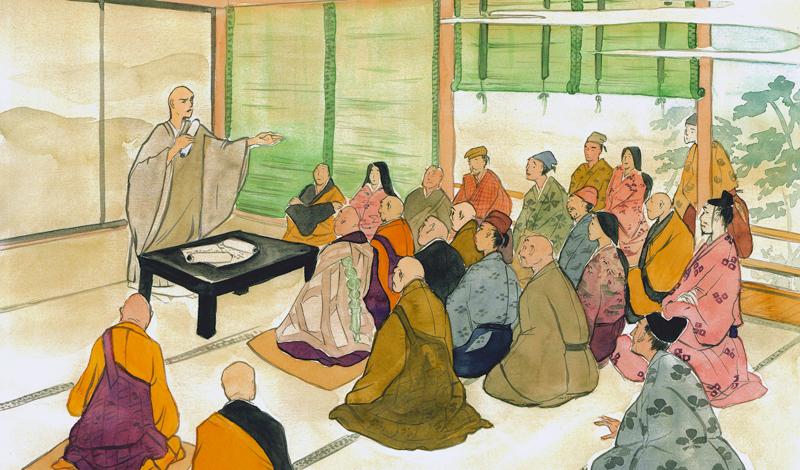
The Story of Nichiren
- 1222
1222 — A Fisherman's Son
Nichiren Buddhism doesn't start with a temple or a tradition. It starts with one person asking a very specific question: what teaching actually works for ordinary people living in chaotic times?
The person asking was a monk named Nichiren. Born on February 16, 1222, in a tiny coastal fishing village in what is now Chiba Prefecture, Japan, the son of a fisherman with no money, no connections, no obvious path to influence. He entered monastic life young and spent years traveling Japan's major Buddhist centers, studying everything he could find. After all that study, he landed on one conclusion: the highest expression of Shakyamuni Buddha's teachings was the Lotus Sutra, a Mahayana scripture compiled around 50–150 CE.
- 1253
1253 — The Declaration
On April 28, 1253, at age 32, Nichiren climbed a hill and made a public declaration. He chanted Nam-myoho-renge-kyo, a phrase expressing devotion to the Lotus Sutra, and announced that this practice was the path to genuine enlightenment for all people. Not someday, in some future life. Now. In this body, in this lifetime.
His central argument was radical for the era: every person, regardless of gender, birth status, intelligence, or past actions, already possesses an inherent Buddha-nature. You don't need to be special. You don't need to transcend the world. You just need to activate what's already inside you.
Nichiren wasn't operating in a stable environment. Japan was in the middle of a seismic power shift, from a noble class to a shogunate military government. Natural disasters, famine, and social chaos were constant. Nichiren wasn't subtle about connecting the dots: he believed the suffering around him was directly tied to people's reliance on teachings he considered distorted and ineffective.
He published sharp critiques of the dominant Buddhist schools of his day: Pure Land, Zen, Shingon, and Ritsu, arguing that each had moved away from the Lotus Sutra's core teaching. These critiques made him powerful enemies. He was arrested. Exiled. Sentenced to execution at one point, a sentence that, according to accounts of his followers, was stopped at the last moment.
Each time, he came back. Each setback deepened his conviction instead of breaking it.
- 1274
1274 — Mount Minobu & the Gosho
Nichiren spent his last years (1274–1282) at Mount Minobu in Yamanashi Prefecture, training disciples and writing letters and treatises that now form the scriptural foundation of the tradition, collectively called the Gosho. He also inscribed Gohonzon, sacred mandala scrolls representing the enlightened state of life, for his followers to use as a focus for their practice.
- 1282
1282 — The Lineage Continues
He died in 1282 at the age of 60. Six main disciples continued his work, and over centuries their lineages diverged into the various Nichiren schools that exist today, including Nichiren-shū, Nichiren-shōshū, and the lay organization Soka Gakkai, founded in 1930 by Tsunesaburo Makiguchi.
- Today
Today — From 1253 to Las Vegas
What Nichiren started in a feudal Japanese fishing village is now practiced by over 11 million people in 192 countries. The Soka Gakkai International, the organization that SGI-USA Las Vegas is part of, carries forward his core conviction: that every single person, right now, in this life, has the capacity to be genuinely and deeply happy.
Not through escape. Not through waiting. Through showing up, chanting, and trusting that the greatness is already in there.